Choreographing Conflict: Safety, Illusion, and Narrative in Stage Combat
The Anatomy of Illusory Violence on Stage
Stage combat begins with a paradox. The audience must believe that a body is threatened, struck, thrown, restrained, or even killed, while the performers remain protected from the consequences of genuine violence. The closer the illusion comes to danger, the more disciplined the underlying process must be. Every apparent impact depends on controlled distance, repeatable timing, clear communication, and a shared understanding that safety is not separate from the performance. It is the condition that makes performance possible.
Fight direction therefore serves the dramatic text rather than existing as physical spectacle alone. A sword clash can expose status, a missed blow can reveal hesitation, and a carefully designed fall can mark the precise moment a character loses control. The performer is not approaching a fight with genuine combative intent. The work is collaborative theatrical partnering, in which both people contribute to a legible image and protect the other person”s physical and emotional boundaries. Understanding the foundational disciplines of stage combat reveals how historical martial techniques are adapted specifically for dramatic storytelling.
Bridging the Divide Between Martial Realism and Performance Art
Real-world combat and performance art have influenced each other for centuries. Martial forms may contain ritual, rhythm, display, and psychological preparation, while theatre has borrowed recognizable guards, attacks, formations, and weapons to communicate conflict quickly. Yet the shared vocabulary can conceal a significant technical divide. A martial artist may train to stop an opponent, create a tactical advantage, or withstand resistance. A stage combatant trains to create the appearance of those actions while preserving a predetermined outcome and protecting a partner.
Theatre also prioritizes legibility. A technically efficient movement can be too small, too fast, or too hidden to read from the back row. Conversely, an expansive theatrical action may be strategically foolish in an actual fight but visually precise in performance. The fight director must translate force into composition, ensuring that the audience sees the threat, understands the relationship, and registers the emotional consequence. As explored in Tony Wolf”s foundational essay, Thoughts on the Martial Arts/Performing Arts Dichotomy, the cross-pollination between historical swordplay and theatrical performance requires deliberate compromises in distance and timing.
The following distinctions help a production team avoid importing the wrong assumptions into rehearsal:
| Combat training | Performance combat |
|---|---|
| Seeks effectiveness against resistance | Seeks a convincing, repeatable illusion |
| Adapts to an unpredictable opponent | Uses agreed sequences and reliable cues |
| Often minimizes unnecessary movement | May enlarge movement for audience visibility |
| Measures success through tactical outcome | Measures success through safety, clarity, rhythm, and story |
This distinction does not diminish martial expertise. It clarifies where that expertise belongs and where specialist theatrical instruction is required. A performer with fencing, boxing, or wrestling experience may bring valuable coordination and body awareness, but prior training does not automatically authorize independent choreography. The safest production treats every sequence as a designed system, assessed by a competent fight director and adjusted to the performer, space, costume, props, and production schedule.
The Neuromuscular Architecture of Stage Safety
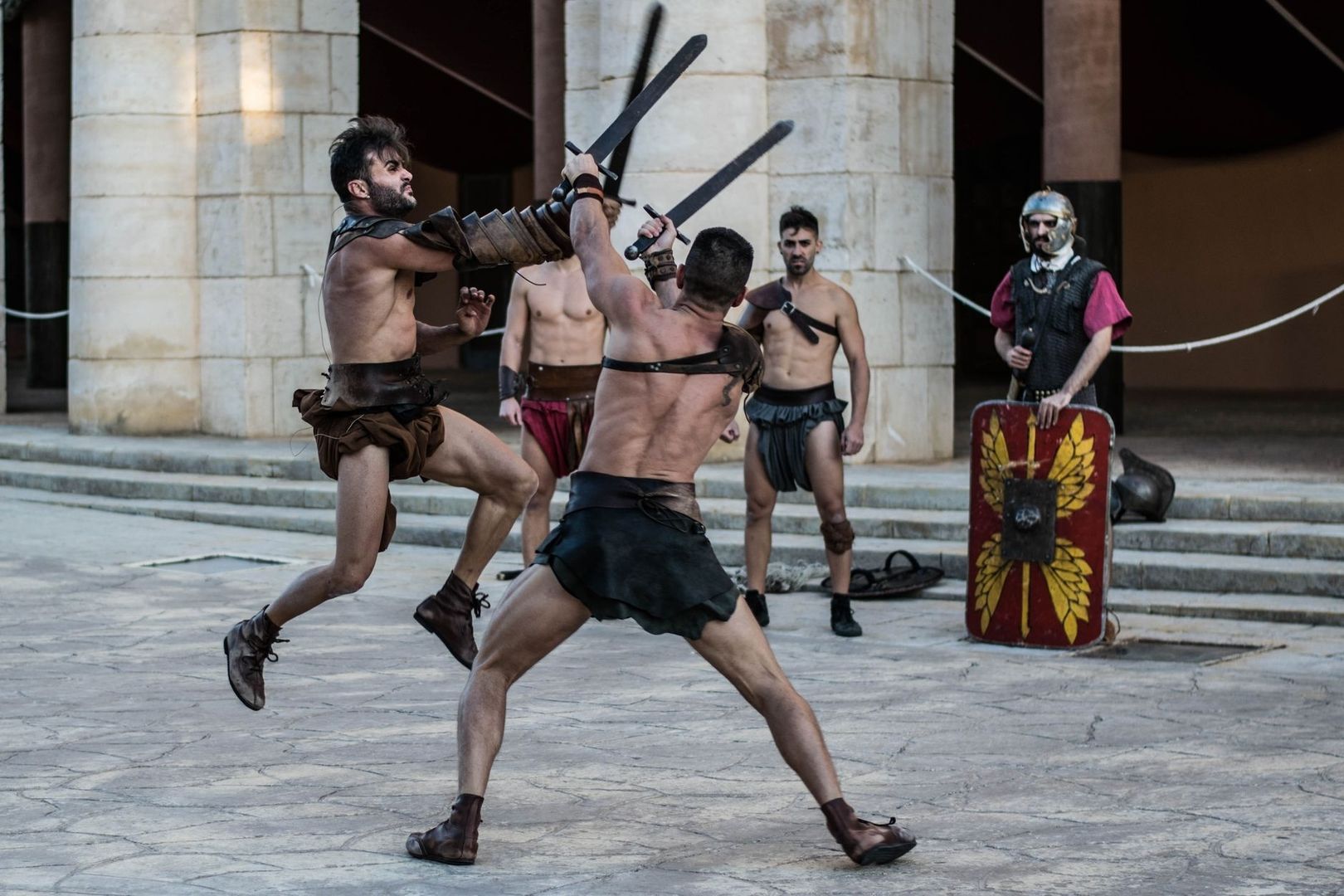
Safety is built into the body”s pathways before it is visible in the finished image. A staged punch usually travels past its target rather than into it. A blade attack is directed off line, with the apparent point passing away from the partner”s vital space. The audience”s sightline, the actors” orientation, and the use of forced perspective combine to make a safe distance appear dangerous. Small changes in angle can determine whether a sequence reads as a direct hit or an evasive near miss.
The sound of violence is often separated from the physical event. A knap, created by a performer”s hand or body contacting a safe surface at the correct moment, can suggest impact without transferring force to the partner. Vocalizations, breath, footwear, costume movement, and carefully placed reactions add further layers of acoustic deception. The sound must be rehearsed as part of the action, not improvised afterward, because a premature or delayed knap can disrupt timing and encourage performers to compensate physically.
Before a dangerous sequence begins, performers need more than a general sense of trust. They need specific protocols. Eye contact can confirm readiness, while a spoken or agreed nonverbal check can pause the action if concentration, spacing, or equipment has changed. Risk assessments should address direct hazards such as cuts, falls, and collisions, as well as indirect hazards including repetitive strain and hearing damage. The Ontario safety guidelines emphasize competent choreography, adequate rehearsal, equipment inspection, secure storage, and work plans suited to the performers” skills and limitations.
- Establish a target and an off-line pathway for every apparent strike.
- Confirm sightlines so the audience sees the illusion without requiring unsafe proximity.
- Separate impact sound from physical contact whenever possible.
- Use agreed readiness checks before each high-risk phrase.
- Stop and reassess when fatigue, costume changes, props, scenery, or spacing alter the original conditions.
The Rehearsal Pipeline from Slow Mechanics to Emotional High Stakes
A reliable rehearsal process moves from mechanics to rhythm, and only then to emotional intensity. At quarter speed, performers identify foot placement, hand positions, balance, breathing, and recovery points. The purpose is not to make the sequence look finished. It is to build a shared map that can be repeated under pressure. Each action should have a clear initiation, pathway, target, response, and reset. Once the mechanics are stable, speed can increase in controlled increments while the fight director monitors distance and consistency.
Consent and boundaries belong at the beginning of this process, not as an afterthought. A performer should be able to identify areas of physical sensitivity, limitations, and actions that require additional discussion. Contact choreography benefits from the same clarity used in intimacy practice: define the action, define the permitted contact, agree on a stop signal, and avoid treating discomfort as a test of professionalism. Emotional intensity must never be used to justify unplanned contact or a deviation from the agreed choreography.
Production safety continues after rehearsal. Daily fight calls allow the cast to check spacing, props, footwear, surfaces, and any sequence involving unusual risk. Weapons must be inspected and maintained by designated personnel, with replicas and blunted items stored, transported, and controlled according to the production”s safety plan. Firearms and firearm replicas require especially strict handling, and live ammunition must never be present in theatrical use. Stage management should document changes, communicate them across departments, and ensure that a substitute or understudy has the same information and training as the original performer.
- Begin with a risk assessment covering bodies, weapons, scenery, flooring, lighting, sound, and audience proximity.
- Teach the sequence slowly, identifying boundaries, cues, recovery positions, and emergency stops.
- Repeat at measured speeds until the physical pattern is consistent without conscious searching.
- Add breath, vocal reaction, character objective, and musical or textual timing.
- Conduct a daily fight call and report any injury, near miss, equipment fault, or unexplained change.
Kinetic Narrative and Emotional Arc in Physical Confrontation
Choreography becomes dramatically useful when every physical choice expresses an objective. A character who wants dominance may control distance and force the other person backward. A character seeking escape may turn the room into a series of barriers. A supposedly weaker figure may win through timing, leverage, or moral certainty rather than raw strength. The fight director and director should identify what each person wants before selecting a technique, because the same parry or grip can communicate fear, contempt, desperation, or reluctant protection depending on its timing and quality.
Spatial relationships make invisible conflict visible. A fight that begins across a wide stage can compress as trust collapses. A character once surrounded by allies may become isolated at the edge of the playing space. Pauses can reveal a decision more powerfully than continuous motion, while a sudden loss of balance can externalize a change in status. In productions that use combat as a major storytelling language, physical staging can clarify relationships that dialogue leaves unresolved. The action should therefore alter the narrative, not merely interrupt it. Each exchange needs a beginning, escalation, reversal, consequence, and emotional landing.
Executing Controlled Chaos on Opening Night and Beyond
The apparent spontaneity of a compelling fight is the visible result of rigorous discipline. Performers can access fear, rage, grief, or surrender more fully when the physical structure is dependable. Safety allows attention to move away from survival and toward character. That is the central artistic advantage of choreography: controlled conditions create room for genuine vulnerability without requiring genuine harm.
Long runs demand continuing collaboration. Bodies change, floors become familiar in different ways, costumes wear down, props are replaced, and concentration fluctuates across performances. Fight directors, actors, stage managers, wardrobe teams, props staff, and technicians must keep communicating rather than assuming that a sequence is safe because it worked previously. The strongest production treats trust as an active practice, maintained through precise calls, honest reporting, respectful boundaries, and readiness to revise. When that process is protected, theatrical violence can remain vivid, coherent, and emotionally dangerous while the people creating it remain physically safe.